
SANZ Multimedia Content
Multimedia content explaining important issues around infrastructure providers.
 Featured
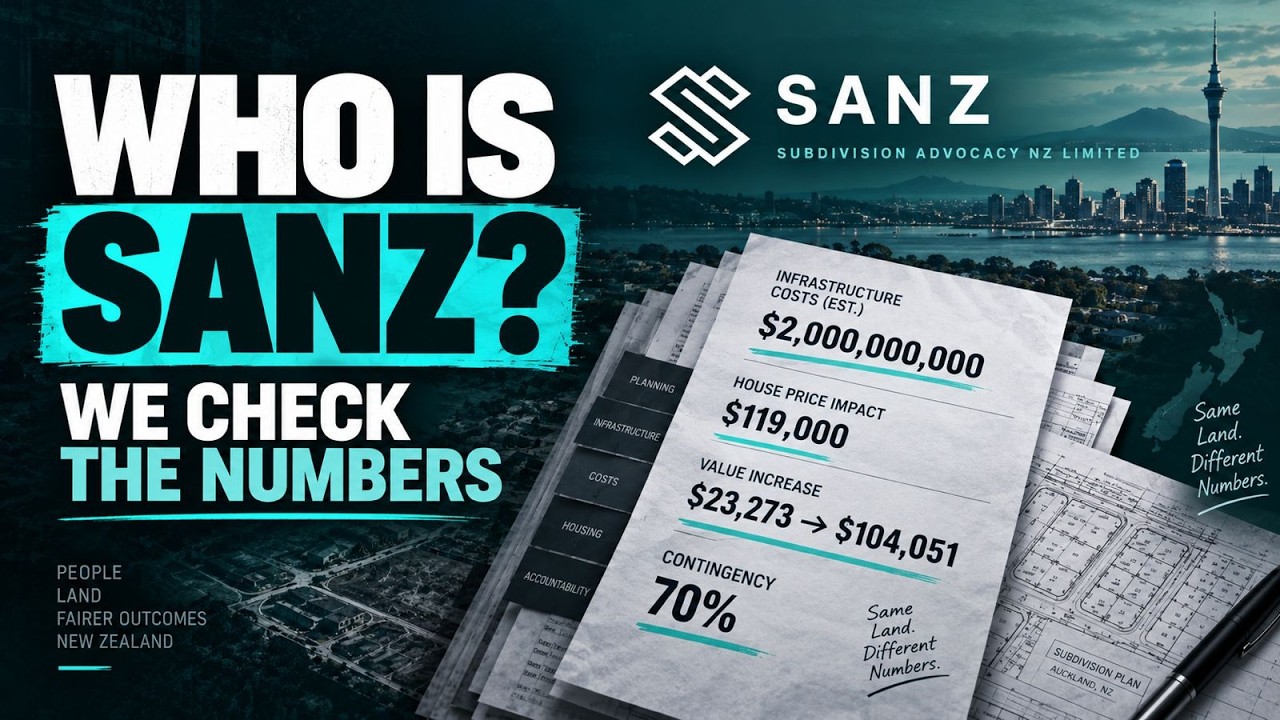
Who is SANZ? We Check the Numbers
September 2026
Good housing is a human essential. New houses must be built to keep the supply running. SANZ is a watchdog. We are evidence based and we are a network of interconnected people: now well over 16,000. Together we look for fairness. We also inform.
Watch now
What costs go into an affordable 3 bedroom home in Auckland
September 2026
Good housing is a human essential. New houses must be built to keep the supply running. SANZ is a watchdog. We are evidence based and we are a network of interconnected people: now well over 16,000. Together we look for fairness. We also inform.
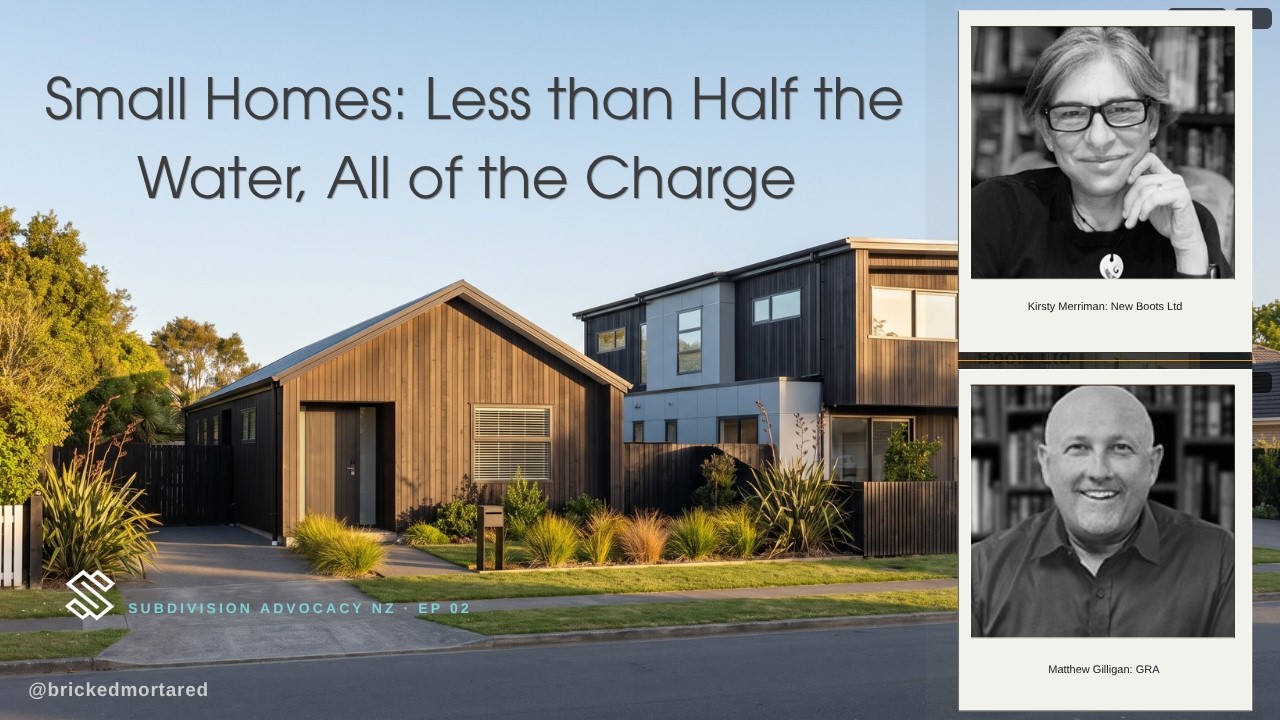
Small homes subsidise large homes for water connections
August 2026
Talking about things that are happening in residential property development. The stories and observations are real and current: feasibilities, good things that happen, disputes, infrastructure challenges, interesting related travel, and council planning. By sharing our collected experiences and of others we hope to make our collective property developments easier.
The only solution was to underground the wires, until they had to pay!
August 2026
Talking about things that are happening in residential property development. The stories and observations are real and current: feasibilities, good things that happen, disputes, infrastructure challenges, interesting related travel, and council planning. By sharing our collected experiences and of others we hope to make our collective property developments easier.
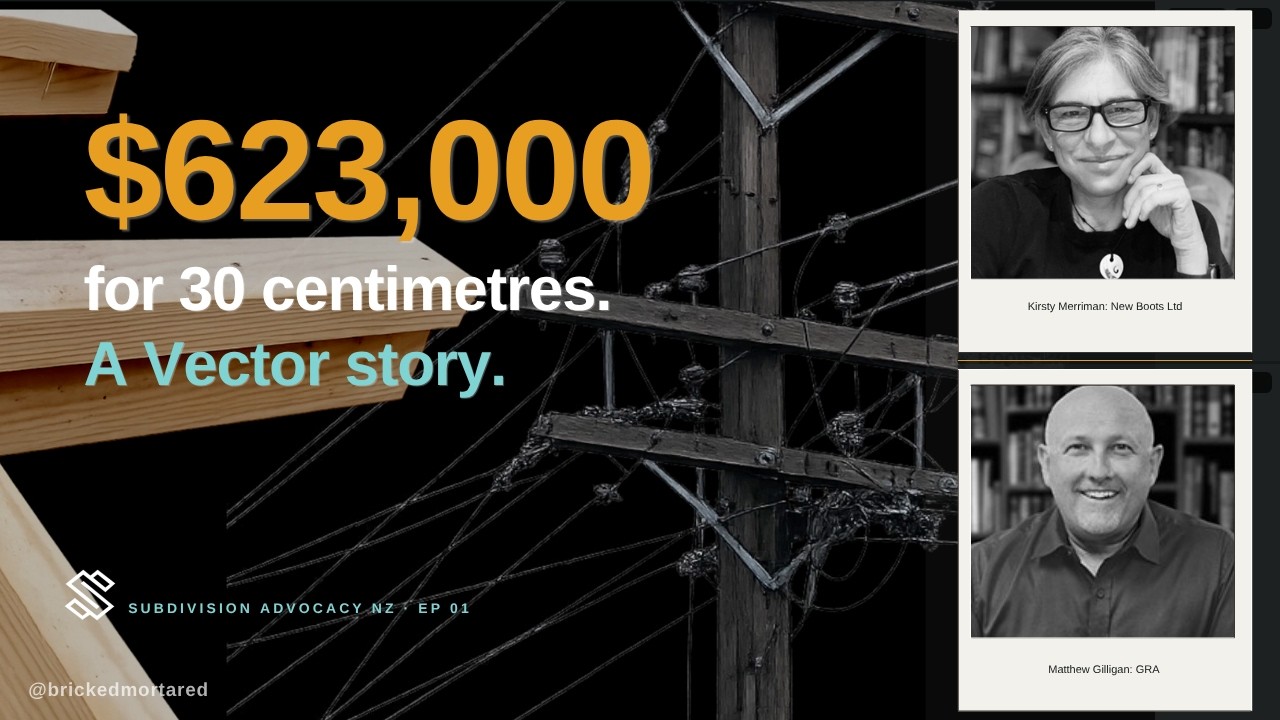
$623,000 for 30 centimetres.
August 2026
Explaining why housing can be so expensive. One story at a time.

Auckland Council's Flawed Excel Model for 2025 Development Contributions
March 2025
In this episode of Bricked and Mortared, Kirsty Merriman discusses the challenges facing Auckland's housing development sector, particularly focusing on the rising costs associated with development contributions. She highlights the flaws in the current cost calculations, the unrealistic forecasts for housing growth, and the impact these issues have on affordable housing development. Kirsty advocates for a reevaluation of the current system to better support developers and ensure the construction of affordable homes.

Navigating Vector Connections: stop being price takers
February 2025
In this episode of Bricked & Mortared, Kirsty Merriman discusses the complexities of utility connections, particularly focusing on Vector connections. Joined by Daniel Dry, a registered electrician, they explore the challenges faced by property developers in coordinating utility connections, the importance of early planning, and strategies for cost savings. The conversation emphasizes the need for professional coordination and the role of project managers in navigating the application process effectively. Takeaways Utility connections can be frustrating and costly. Project managers need to take charge of the connection process. Early planning can significantly reduce costs. Understanding the design and application process is crucial. Coordinating multiple utility connections can lead to savings. Capacity checks can prevent unnecessary expenses. Avoid complex connections to save money. Professional coordination is essential for efficiency. Know your infrastructure before starting a project. Finding the right tradespeople can streamline the process. Chapters 00:00 Introduction to Utility Connections and Vector 02:48 Challenges in Utility Connections 05:23 Design and Application Process for Connections 08:28 Cost-Saving Strategies for Utility Connections 11:04 Importance of Early Planning and Coordination 13:57 Taking Control of the Connection Process 16:39 Finding the Right Professionals for Utility Connections 21:18 New Chapter #vector #subdivision #construction #infillhousing @BrickedMortared
Auckland Council's Cost Escalations: $30 million to $250 million
January 2025
In this conversation, Kirsty Merriman discusses the significant increase in development contributions proposed by the Auckland City Council for 2025, which could severely impact the affordability and feasibility of new home builds in the region. She highlights the complexities and hidden costs associated with these contributions, the assumptions made by the council, and the implications for future housing development. The conversation emphasizes the need for transparency, fairness, and a reevaluation of the current policies to ensure sustainable growth and affordability in Auckland's housing market. Takeaways Development contributions are set to increase significantly in Auckland. Home builders may face costs exceeding $100,000 for new builds. The council's cost estimations for infrastructure projects are concerning. There is a lack of transparency in how development contributions are calculated. Assumptions about housing density and impervious surfaces are outdated. The disparity in contributions between private developers and Kainga Ora raises equity issues. Future housing affordability is at risk due to inflated development costs. The council's management of infrastructure projects needs scrutiny. There is a pressing need for infrastructure to support growth in Auckland. Community awareness and discussion are crucial for policy review. Keywords Auckland, development contributions, housing, infrastructure, costs, home building, property development, local government, affordability, urban planning Chapters 00:00 Understanding Auckland's Development Contributions 02:15 The Real Costs of Infrastructure 04:36 Cost Escalation and Project Management 07:15 Assumptions and Flawed Calculations 09:21 Impact on Affordable Housing 12:08 Equity and Fairness in Development Contributions 12:44 New Chapter 14:43 The Future of Housing Affordability 17:08 Conclusion

Auckland Infrastructure Problem Webinar
November 2024
November 2024: Recorded webinar with Matthew Gilligan and Kirsty Merriman, hosted by NZPM.
The construction management model opposed to using the traditional head contractor model
September 2024
Summary In this episode, Kirsty Merriman discusses her construction management model and why she doesn't use the traditional head contractor model. She explains that in her model, she is the developer and takes responsibility for the project. She works with a team of legal advisors, financial advisors, and construction management experts. She directly hires and pays the tradespeople and maintains open communication with them. Kirsty compares her model to the traditional head contractor model, highlighting the lack of control and communication in the latter. She also discusses the unique aspects of her model, such as separate payment for materials and labor, and the importance of trust and collaboration. Keywords construction management, head contractor model, developer, team, tradespeople, communication, control, traditional model, unique aspects, trust, collaboration Takeaways Construction management is an alternative model where the developer takes responsibility for the project and works with a team of experts. In the traditional head contractor model, the developer has less control and communication with the subcontractors. The construction management model allows for direct hiring and payment of tradespeople, leading to better communication and quality control. Transparency, collaboration, and trust are key elements of the construction management model. Chapters 00:00 Introduction and Overview 03:25 Comparison of Construction Management and Head Contractor Models 07:24 The Unique Aspects of the Construction Management Model 10:19 Considerations and Challenges of the Construction Management Model 11:47 Benefits of Transparency, Collaboration, and Trust 12:16 Conclusion

Energy: give thought to the whole picture, especially the end point.
August 2024
Summary In this episode, Kirsty Merriman discusses the H1 issue in residential construction and the need to level up our homes. She explains the three methods of approaching H1: the schedule method, the calculation method, and the ideal method. Kirsty emphasizes the importance of considering the total picture when designing homes and highlights the need for better design and technology. She also discusses the challenges with the schedule method and shares her experience using the calculation method and modeling method. Kirsty concludes by urging the industry to think about building homes for the future and to consider energy, ventilation, and overall consumption. Keywords residential construction, H1 issue, level up homes, schedule method, calculation method, ideal method, better design, technology, energy modeling, ventilation, consumption Takeaways The residential construction industry needs to consider the total picture and think about building homes for the future. The schedule method of approaching H1 leads to over-engineered homes and complaints of overheating. The calculation method and modeling method offer better ways to design energy-efficient homes. Designers, builders, and architects should consider using AI and optimization tools to improve home design. Ventilation is a crucial aspect of home design that needs to be considered alongside insulation. The industry should focus on building homes for 2025 and beyond, considering overall consumption. Sound Bites "The residential construction industry seems to do things without giving enough thought to the whole picture, the end point." "If you follow that schedule method, you can pretty much guarantee you're going to pass. But you're also pretty much going to guarantee you've got an over-engineered home." Chapters 00:00 The Importance of Considering the Total Picture 00:54 Approaching the H1 Issue: Schedule, Calculation, and Ideal Methods 02:21 Limited Productivity Gains in the Construction Industry 03:16 Designing Homes for the Future 07:27 The Model Method for Energy Efficiency 11:24 Building for the Future: Consumption and Design
Issue of contribution over-payments
August 2024
Summary In this conversation, Kirsty Merriman discusses stormwater development contributions and how they can impact the cost of building detached and duplex houses in Auckland. She explains the concept of stormwater development contributions and why it has become an issue. Kirsty also delves into the process of charging for stormwater development contributions and highlights the need for fairness and equity. She provides an example to illustrate how overpayment can occur and shares steps to challenge and reassess the contributions. Kirsty emphasizes the importance of reviewing the policy and advocating for a more reasonable approach. Keywords stormwater development contributions, impervious surface area, cost, infrastructure, fairness, equity, overpayment, reassessment, policy takeaways Stormwater development contributions are charges for the cost of infrastructure required to deal with stormwater runoff from new developments. The current method of charging for stormwater development contributions in Auckland may result in overpayment, especially for compact and infill housing. It is possible to challenge and reassess stormwater development contributions if they are deemed unfair or inequitable. Reviewing the policy and advocating for a more reasonable approach to charging for stormwater development contributions can lead to significant cost savings for developers. Links https://kirstymerriman.com https://www.aucklandcouncil.govt.nz/building-and-consents/development-contributions/Pages/default.aspx https://www.aucklandcouncil.govt.nz/plans-projects-policies-reports-bylaws/our-policies/development-contributions-policy/Pages/development-contributions-policy.aspx 00:00 Introduction and Cost Savings 01:01 Understanding Stormwater Development Contributions 03:11 The Issue of Overpayment 05:34 Challenging and Reassessing Contributions 10:54 Advocating for Fairness and Equity
The real cost of infrastructure in property development
July 2024
Summary In this conversation, Kirsty Merriman discusses the major issues and costs associated with building infrastructure in property development. She highlights the challenges of outdated and insufficient infrastructure, the need for coordination among developers, and the high costs of connecting to public networks. Kirsty also explores the feasibility of projects and the impact of infrastructure costs on profitability. She suggests potential solutions such as trimming infrastructure costs and exploring alternative funding sources. Keywords infrastructure, property development, costs, coordination, feasibility, outdated infrastructure, public networks, profitability, solutions Takeaways Outdated and insufficient infrastructure is a major challenge in property development, particularly in areas with brownfield sites and old pipe work. Coordinating infrastructure upgrades among developers is difficult, and there is currently no mechanism to share the costs. Connecting to public networks, such as fiber optic cables, electricity, water, and wastewater, incurs significant costs that can impact project feasibility. Infrastructure costs can make projects unviable, especially when combined with other expenses like design, earthworks, and build costs. Potential solutions include trimming infrastructure costs, reassessing contributions, and exploring alternative funding sources. Titles The High Costs of Connecting to Public Networks Coordinating Infrastructure Upgrades Among Developers Sound Bites "We're increasing intensity of our developments and we need to make sure that the pipes and the schools and the community facilities can cope with the number of people. But it's going to cost money." "It would have been far better if it was one company doing it." "You need to look at these things in detail and know them and don't go unconditioned on a site until you know it." Chapters 00:00 Introduction and Overview of Infrastructure Issues 02:27 Challenges of Coordinating Infrastructure Upgrades 05:21 High Costs of Connecting to Public Networks 07:18 Impact of Infrastructure Costs on Project Feasibility 10:15 Exploring Potential Solutions for Managing Infrastructure Costs

Why projects don't stack, and how to make them work
July 2024
Summary In this conversation, Kirsty and Paul discuss projects that don't stack, the reasons behind their failure, and strategies to make them viable. Kirsty shares her experience with projects that have come to a grinding halt due to factors like increased interest rates and rising construction costs. She also explains how she has made her current project stack by acquiring land at a good price, self-banking, staging the project, and managing margins. Paul adds that the cost of construction has come down, allowing for higher margins. They conclude by mentioning that the next episode will focus on disputes and problem-solving. Keywords projects, infrastructure, stacking, resource consent, building consent, construction costs, interest rates, pre-sales, typologies, staging, margin management, cost of construction, subcontractors, main contractor, disputes, problem-solving Takeaways Projects that don't stack often fail due to factors like increased interest rates and rising construction costs. Strategies to make projects stack include acquiring land at a good price, self-banking, staging the project, and managing margins. The cost of construction has come down, allowing for higher margins. In some cases, becoming the main contractor and employing sub-trades directly can help make projects viable. The next episode will focus on disputes and problem-solving in the construction industry. Titles Managing Margins and the Cost of Construction Why Projects Don't Stack: Factors and Challenges Sound Bites "Projects are just not moving forward." "You can only get this thing called a pre-sale." "Staging... that's actually very important." Chapters 00:00 Introduction and Setting the Topic 01:34 Why Projects Don't Stack 04:28 Strategies to Make Projects Stack 08:42 Managing Margins and the Cost of Construction 13:51 Innovative Approaches: Becoming the Main Contractor

Introducing Bricked & Mortared
July 2024
Kirsty introduces Bricked & Mortared covering things that are happening in residential property development. The stories and observations are real and current: feasibilities, good things that happen, disputes, infrastructure challenges, interesting related travel, and council planning. By sharing our collected experiences and of others we hope to make our collective property developments easier.