
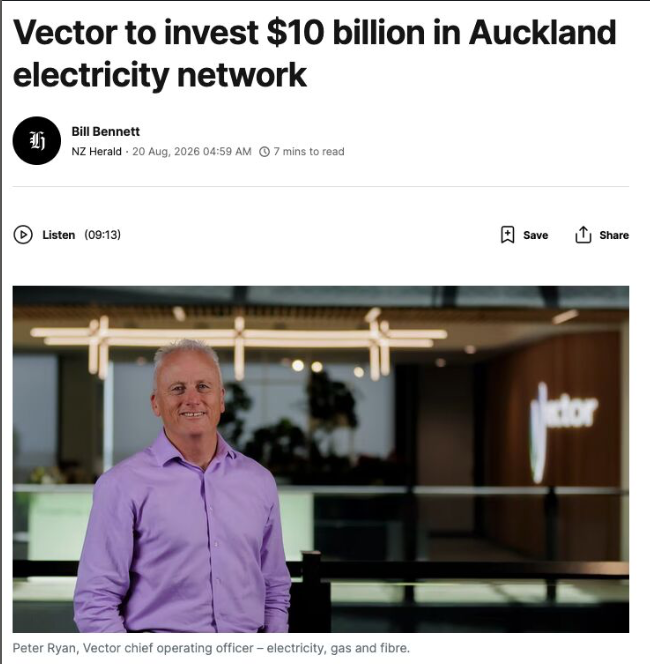
SANZ lodged a complaint with the New Zealand Herald this morning about an article published on 20 August. The Herald reported that Vector is investing $10 billion in Auckland’s electricity network. Vector’s disclosures to the Commerce Commission say $2.4 billion over the past decade, and $4.1 billion forecast for 2026 to 2036.
The difference is capital contributions, and who actually pays them. That is money paid by developers and new home buyers for their connections. Some of it is a growth charge. The larger part is installation works. Vector does not fund that, it mostly coordinates it, so I do not count it as Vector’s investment.
The NBR reported the same pattern on 18 August, using Vector’s annual result. Electricity “investment” came to $512 million, of which $191 million was capital contributions, nearly 40 per cent funded by new homes.
Vector’s chief executive said the firm had invested that in growing Auckland’s electricity network.
Some of that $125,000 came from the purlin story I shared a couple of weeks ago, for new homes. I would put it to Vector’s chief executive that this was not Vector’s investment. It was new homes’ payment for maintenance on a pole that no longer passed the structural integrity test. I have the test data. Vector would not let the developer de-energise the lines for a couple of hours to fix it properly. That was not growing the network.
The developer and the homeowners paid their growth contribution on top of that.
Connection contributions fell $20 million. Some of us pushed back and got Vector to agree that we could do the civil work ourselves. Vector still quotes for that work, then charges $300 to take it back off the quote. A past Vector quote of $32,000 for reinstatement dropped to $2,400 once a private company did the work instead.
Questions I would like journalists to put to Vector: who actually pays for Auckland’s network growth? Why did the average new connection cost rise from $5,645 in 2020 to $9,376 in 2022? Why did Vector move from a combined rental and upfront charging structure to solely upfront charges for new connections in 2021? What happens when the rates used to charge capital contributions also go into the regulated asset base and come back through everyone’s monthly bill? Vector says the old combined structure was not fair. Why?
The Electricity Authority is already reviewing connection pricing. The Commerce Commission wrote on 13 August setting expectations for competition in connections. The information is public. It needs someone to ask, and to think past the sound bites.